Browse help
What is the Client analysis report for?
This report shows you who your best clients are, how they pay and how much your revenue depends on just a few of them.
Example. Omar runs a cleaning company in Marrakech. The report shows him that his top three clients account for 70% of his revenue, and that one of them pays on average after 58 days. He negotiates a down payment with this client and prospects to diversify his client base.
Menu Rapports → Analyse clients (Reports → Client analysis), in the « Clients » section. This report depends on your subscription: if it is not included, it does not appear in the submenu, its card in Rapports → Vue d'ensemble (Reports → Overview) shows a padlock with the name of the plan that offers it, and the page shows « Disponible à partir du plan … » (Available from the … plan) and a « Voir les plans disponibles » (See available plans) button. It does not appear in the external accountant's menus.
1. What is counted
- Issued invoices whose issue date falls within the period, excluding drafts and cancelled invoices.
- Valid credit notes issued in the period are deducted from the client's revenue, on their issue date.
- An invoice cancelled by a credit note stays in the revenue of its period (offset by the credit note), but counts neither in collected amounts, nor in the balance, nor in payment behaviour.
2. The four cards
All four cards follow the chosen period:
| Card | What it means |
|---|---|
| Clients actifs (Active clients) | The number of different clients invoiced in the period (subtitle « Facturés sur la période », Invoiced over the period), excluding drafts and cancelled invoices. |
| Nouveaux clients (New clients) | The number of client records created in the period (subtitle « Créés sur la période », Created over the period), whether or not they have been invoiced. |
| CA total (Total revenue) | The period's revenue excl. VAT, net of credit notes. The « Moy. » (Avg.) mention gives the average revenue per invoiced client. |
| Clients en retard (Late clients) | The number of different clients who have at least one invoice issued in the period that is past due and still unpaid today (subtitle « Facture échue impayée », Overdue unpaid invoice). A client with three overdue invoices counts as one. |
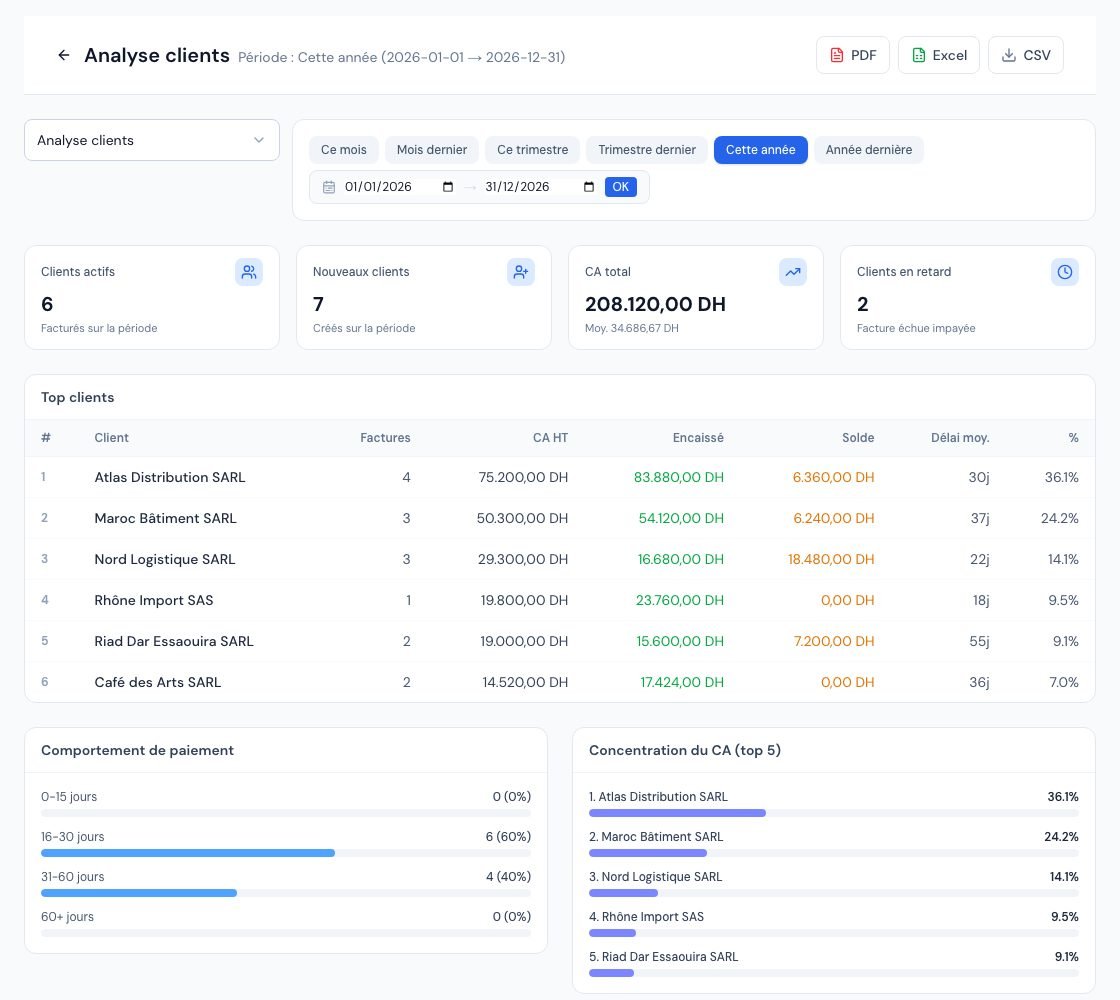 The « Analyse clients » (Client analysis) report with the four cards and the « Top clients » table.
3. The « Top clients » table
It lists the top 20 clients by revenue excl. VAT over the period:
- #: the rank; Client; Factures (Invoices): the number of invoices in the period.
- CA HT (Revenue excl. VAT): the total excl. VAT of the invoices, minus the client's credit notes for the period.
- Encaissé (Collected) and Solde (Balance): what has already been paid and what remains to be paid on the period's invoices, as of today.
- Délai moy. (Avg. delay): the average number of days between the issue date and the full payment date of paid invoices (for example « 23j », 23 days); « — » if no invoice of the period has been paid yet.
- %: the client's share of the period's total revenue.
4. Payment behaviour and revenue concentration
- Comportement de paiement (Payment behaviour): the period's paid invoices, broken down by the delay between issue and payment: « 0-15 jours » (0-15 days), « 16-30 jours », « 31-60 jours » and « 60+ jours », with their number and share. The bigger the « 0-15 jours » bar, the faster your clients pay.
- Concentration du CA (top 5) (Revenue concentration, top 5): the share of each of your five largest clients. If a single client represents a large share of your revenue, losing them or a late payment on their part would weigh heavily on your cash flow.
5. The « Nouveaux vs récurrents (6 mois) » table
(New vs returning, 6 months.) It always covers the last 6 months, whatever the period chosen. For each month, among the clients invoiced that month:
- Nouveaux (New): those who had received no invoice before that month;
- Récurrents (Returning): those who had already been invoiced before.
For a finer analysis of loyalty (repurchase rate, details per client), use the Client recurrence report.
6. Exporting the report as PDF, Excel or CSV
| Button | Content | Availability |
|---|---|---|
| Opens a preview of the report, with the « Imprimer » (Print) and « Télécharger » (Download) buttons. | Depending on your subscription (PDF export of reports). | |
| Excel | An .xlsx workbook: « Résumé » (Summary), « Top clients », « Comportement de paiement » (Payment behaviour), « Concentration », « Nouveaux vs récurrents » (New vs returning) (and « Société » (Company) with your details). | Depending on your subscription (Excel export of reports). |
| CSV | The « Top clients » table, with « ; » as separator. | Always available. |
A greyed-out button indicates an export not included in your subscription: hover over it to read « Disponible à partir du plan … » (Available from the … plan).
Frequently asked questions
What is the difference between the « Nouveaux clients » card and the « Nouveaux vs récurrents » table?
The card counts the client records created in the period, even if they have not received any invoice yet. The table counts the clients invoiced for the first time each month, over the last 6 months. For a finer analysis, see the Client recurrence report.
A client's average delay is « — » even though they paid me.
The delay is only calculated for the period's invoices that are fully paid. A partial payment or the settlement of an invoice from another period is not counted.
Where can I see the details of overdue invoices?
Open the aging report or the collections module to follow up with the clients concerned.
Can a client's revenue excl. VAT be negative?
Yes, if a credit note issued in the period relates to an invoice from an earlier period: the credit note is deducted, but the original invoice is not in the period.
Next steps
Related articles
Was this article helpful?
Invoice compliantly, effortlessly
DGI-compliant invoices, quotes, credit notes, VAT and supplier tracking in a single tool.
Try it free